Defending the $400,000 salary of incoming San Diego State University President Elliot Hirshman, CSU Chancellor Charles Reed cited a CSU system study that “found Cal State presidents to be underpaid compared to their peers at similar institutions.”
It is nice to know that Chancellor Reed pays attention to the data. Or at least the data that supports an argument for his “operational needs” (a vague term often used by CSU system administrators to explain why they cannot afford to spend more on instruction).
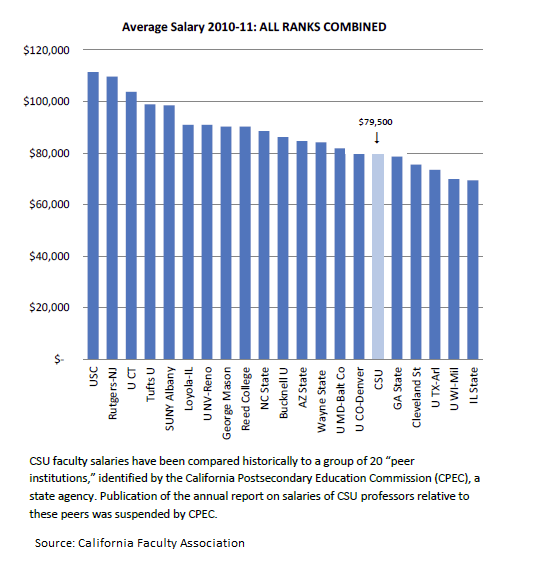 According to a study by the California Faculty Association (CFA), faculty salaries are likewise lagging behind those of faculty at similar institutions.
According to the data the weighted average of all faculty salaries in the CSU is 11% below the average among our peer institutions. Or at least this is CFA’s best guess, since the California Postsecondary Education Commission stopped generating this report.
In the last few years tuition and fees have doubled in the CSU. This puts additional strain–both financially and academically–on students who mostly come from economically modest backgrounds. But, Charlie Reed complains, CSU presidents are underpaid. So in the very same meeting that approved an increase in tuition Reed successfully pushes a $100,000 pay increase for the new president of SDSU.
Where faculty pay increased 28% over the last decade, the salaries of CSU presidents has doubled. Why has the tuition-wage spiral only driven up the pay of presidents and high-level administrators and not the salaries of faculty?
The answer is complex. Partly it has to do with supply. New PhDs are pumped out daily. A constant supply of workers allows administrators to depress faculty wages by replacing departed faculty (many with decades of experience and higher wages) with newer, lower paid faculty. It is rare at most institutions to replace senior faculty with similarly experienced senior faculty.
As a faculty member the quickest way to a pay increase would be to move (or threaten to move, that is, actually have an offer in hand) to another, higher paying position; but those opportunities are rare. Tenure, maligned by some, is sometimes described as the “golden handcuffs” — yes, you have the promise of employment “for life” but your ability to rack up pay increases is limited to non-existent; one is fully at the mercy of the university.
More likely, however, an empty faculty slot will simply be eliminated with the associated courses assigned to adjunct faculty members who are paid much less and in most cases do not get benefits. It is the academic equivalent of outsourcing labor. And every average American knows how outsourcing has depressed wages in the US over the last few decades.
University presidents and high-level administrators are much more mobile. I have been told that the average tenure of a Provost in the CSU is three years. That is not because they are being fired; they are moving on, they are becoming Provosts at larger, more prestigious universities (with higher salaries to boot), or becoming university presidents (with higher salaries…to boot).
So it is partially a matter of supply. Yes there are fewer jobs as university president, but there are also a smaller number of potential candidates. This equals higher wages.
But there is one other factor. Hiring a new university president at, say, a $100,000 pay increase over the previous occupant is easy to defend. Is $100,ooo going to break the bank at SDSU? No. And we need to compete in a market where salaries are spiraling up.
Furthermore, you have this argument, which was actually made by the Chair of the Board of Trustees, Herbert Carter, in defense of the increase: We could fire every administrator in the system and still not deal with the $650,000,000 cut thrown at us by the legislature.
This is how administrator salaries rise incrementally. No single increase will break the system. No single act of holding the line will solve the problem. And so we can “afford” the increase! Brilliant.
But just imagine a 25% single-year increase in faculty salaries. That would break the bank. We cannot do that. In fact, if we were to raise faculty salaries we would have to raise tuition to pay for it; and we can’t raise tuition! Everyone would get mad. It would be a symbolic disaster.
And thus the rich become richer. Administrative salaries increase and faculty are targeted as the source of the problem.