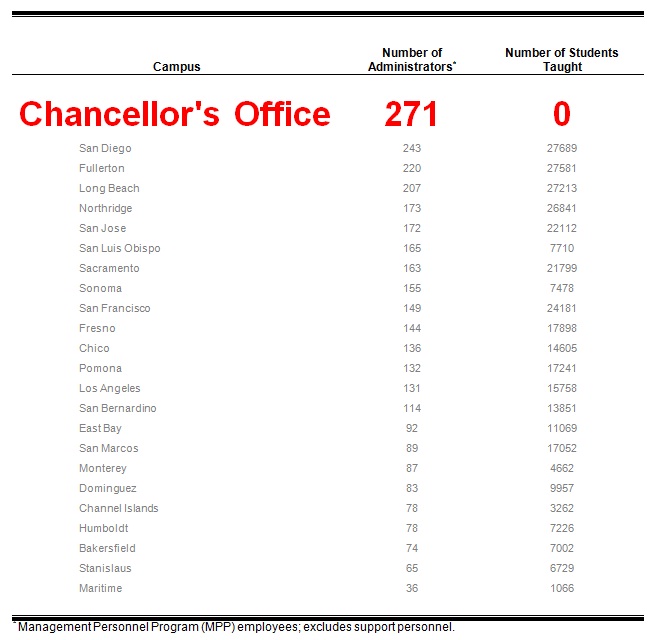
It sounds like the beginning of a joke. I suppose that, in a way, it is.
As a matter of fact universities rely on administrators to do the sort of work that faculty cannot do. We are not able, qualified, nor do we want to run the human resources office, recreation center, or student union. A certain number of administrators are necessary to run a complex organization like a university campus.
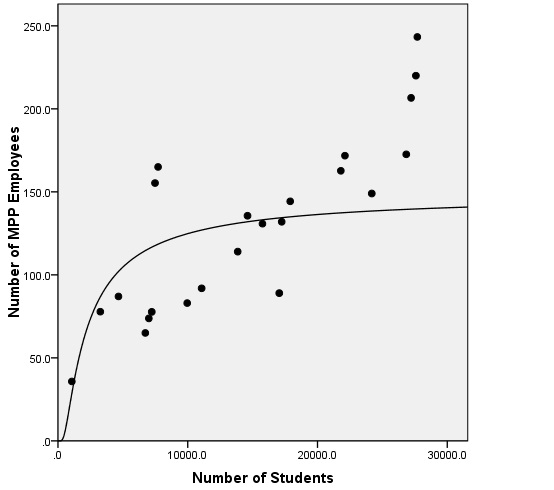 The average CSU has about 130 administrators. In our system they are referred to as Management Personnel or MPPs; this classification excludes support personnel. Typically smaller campuses like Channel Islands have more administrators per student (1 to 42 students) than larger, more established campuses like San Francisco State University (1:162).
The reason for this disparity is that as a campus approaches a student body of 7,500 to 10,000 students the organization achieves an economies of scale that allows for a growth in the number of students relative to administrators. To the extent that economics is capable of establishing “laws,” economies of scale has law-like status in that discipline. As the graph on the left indicates the pattern is not perfect, but it corresponds to general expectations.
So, how many administrators does it take to teach a student in the CSU? System wide the average is one MPP for every 108 students. Predictably the smaller campuses (Maritime, Channel Islands, SLO, Sonoma, and Monterrey) have less efficient ratios than some of our biggest campuses (e.g., San Francisco State and Northridge). Economies of scale.
But which campus is the WORST? Which campus relies on the most MPP employees to educate the fewest students?
THE CHANCELLOR’S OFFICE!
The CO has 271 MPP employees and does not educate a single student; not one. Only the Chancellor’s Office is immune from the laws of economics. With each additional hire they become infinitely less efficient at educating students. It makes one wonder why we have them at all.