Inevitably the reader comments following stories about the increasing cost of a CSU education reflect a consistent sentiment: “When I went to CSU {fill in the blank} I would work during the summer to pay my tuition. Why don’t these lazy kids just get a job!” For our purposes I refer to this commentator as “Old Timer.”
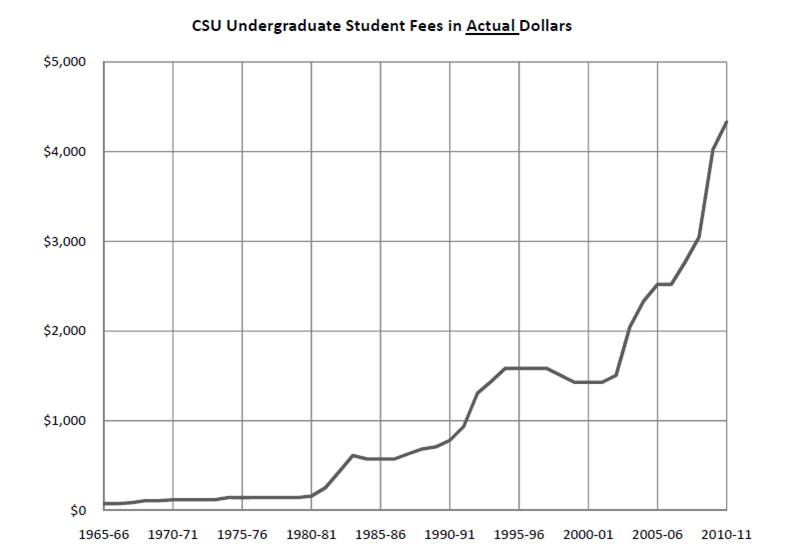 Many of the commentators, I imagine, attended college during the 1960s, 1970s, or 1980s. They seem to have little appreciation for how the cost of a CSU education has increased since the 1990s. As figure 1 indicates, anyone attending a CSU in the 1960s through the 1980s was paying a few hundred dollars in fees to attend college. A summer job could probably pay that bill. In the 1960s—based on a minimum wage of $1.25 per hour—a student would need work about 100 hours during the summer to pay their student fees. In actual dollars since the 1990s undergraduate student fees have increased 500%. Based on today’s minimum wage of $7.25 a student would need to work 579 hours to pay their student fees (excluding taxes).
One might argue that this increase is simply a function of inflation. However, as figure 2 illustrates, even controlling for 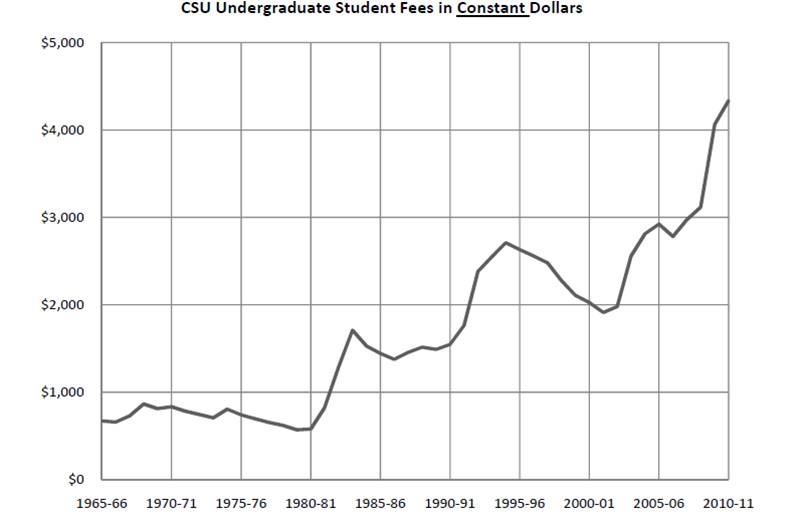 inflation student fees have increased by about 500% between 1960 and 2011. Using the inflation adjusted minimum wage in 1965 a student would need to work 128 hours to pay her CSU student fees compared to 579 hours during the 2010-2011 academic year.
In short, the CSU education that students are paying for today is far more expensive for students than those who attended a CSU a generation ago. Based on my casual observation of my students, many are working 30 and 40 hours a week to pay for their fees and tuition, to say nothing of their rent, car payments, and so forth that are also part of the equation of combining work with a college education.
You do not have to take my word for it. A study by the U.S. Department of Education (scroll to the bottom) shows that the costs of an education in the CSU is skyrocketing.
Students who have to work more will take longer to graduate, and many will fail to graduate due to increasing financial strains. In 2010 the CSU announced a “bold initiative” to increase the overall and the four-year graduation rate. Increases in student fees and tuition work at cross-purposes with the laudable goal of graduating more students more quickly. Once they do graduate they will be saddled with more debt, preventing them from buying homes, new cars, and other big-ticket items.
It is time for California to decide what it values most. Throughout much of the last half-century a world class system of higher education was an economic engine for the state of California. Funding higher education was an investment in economic opportunity. Do we want to continue the legacy, or wave the white flag of surrender? Hey “Old Timer,” are you going to offer this generation the same opportunity that you had, or pull the rug out from under them? Eh, I suppose you don’t care; you’ve got yours, right?