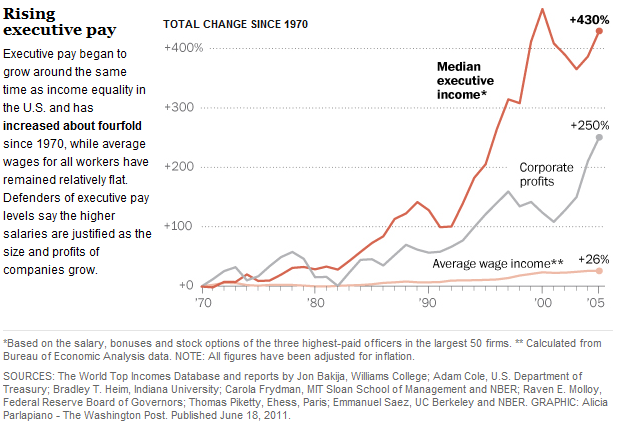
 Recently the Washington Post reported on the growing inequality between the top earners and the bottom 90% of earners in the US. As the graphic to the left indicates, between the 1970s and 2008 median executive pay increased over 400% while the pay of average workers increased by a mere 26% on average. Whether measured by wealth or income, there is an increasing gap between the rich and everyone else in the US.
To illustrate the magnitude of this change Washington Post reporter Peter Whorisky cited the experience of two CEOs:
It was the 1970s, and the chief executive of a leading U.S. dairy company, Kenneth J. Douglas, lived the good life. He earned the equivalent of about $1 million today. He and his family moved from a three-bedroom home to a four-bedroom home, about a half-mile away, in River Forest, Ill., an upscale Chicago suburb. He joined a country club. The company gave him a Cadillac. The money was good enough, in fact, that he sometimes turned down raises. He said making too much was bad for morale.
Forty years later, the trappings at the top of Dean Foods, as at most U.S. big companies, are more lavish. The current chief executive, Gregg L. Engles, averages 10 times as much in compensation as Douglas did, or about $10 million in a typical year. He owns a $6 million home in an elite suburb of Dallas and 64 acres near Vail, Colo., an area he frequently visits. He belongs to as many as four golf clubs at a time — two in Texas and two in Colorado. While Douglas’s office sat on the second floor of a milk distribution center, Engles’s stylish new headquarters occupies the top nine floors of a 41-story Dallas office tower. When Engles leaves town, he takes the company’s $10 million Challenger 604 jet, which is largely dedicated to his needs, both business and personal.
A study of college presidents in the US suggests that there is a similar trend toward income inequality taking place in the world of higher education.
- In 2004 only five college presidents pulled down more than $1 million per year. According to the Chronicle of Higher Education, in 2008 30 private college presidents made more than $1 million dollars per year. That is a six-fold increase in only four years.
- In 2004 only 23 college presidents received total compensation over $500,000. In 2008 over 20 percent (107) of college presidents made over $600,000 in total compensation. That is nearly a five-fold increase.
- Nearly a third of college presidents have compensation packages that put them in the top 1% of income earners in the country.
Bottom line: Increases in college presidents’ compensation has followed a trajectory very similar to that of the top CEOs in the country, while faculty wages (like those of ordinary Americans) have mostly stagnated.
What has happened to faculty salaries of the same period? According to the College Board between 1980 and 2008 total faculty compensation increased from about $65,000 per year to about $90,000 per year. This is a total increase in total compensation of $25,000 per year or about 38%, very close to the 26% average increase enjoyed by average workers over essentially the same period.
It has been fashionable for the last thirty years to demand that government be “run like a business.” Proponents of this view had in mind the supposed “efficiency” of business. Instead university administration has simply mirrored the rising inequality that characterizes modern American life.
In the California State University system, the Chancellor’s pay increased from $254,000 to $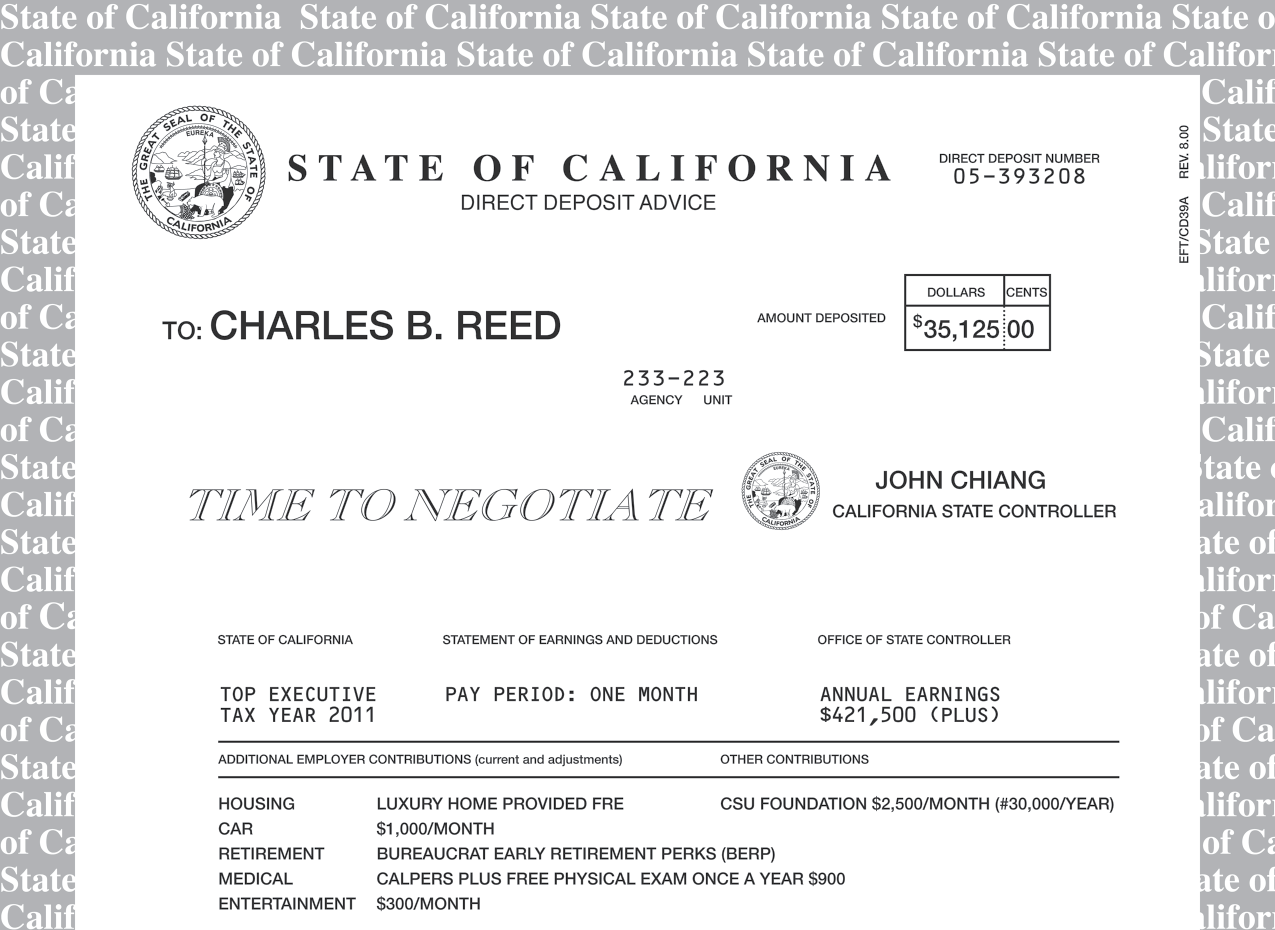 451,000 between 1998 and 2011; that’s 66%. Other top administrators in the system got average pay increases of 69%. The average campus president makes $296,583, up an average of 87% between 1997 and 2011.
Over that same period faculty salaries increased 27%. Administrative pay increases were two to three times what faculty increases amounted to.
When the time comes to explain the rising cost of college tuition, increasing faculty salaries are inevitably the target. As these numbers suggest, one would be hard pressed to make that argument.
Ironically, as college presidents’ compensation packages increase many of them seek a faculty composed of lower wage, adjunct faculty, as I discussed in a previous post.
I am not suggesting that presidential salaries are the main driver of rising tuition costs. The math behind increasing tuition and fees is a lot more complex than that; and reduced state support is a major contributor. But the combined evidence suggests that university faculty are not immune to the trends present in the broader American economy.
If there is to be sacrifice it should begin at the top; and by the “top” I mean the very top. Sacrifice begins on the “Golden Shore.”