In July I comme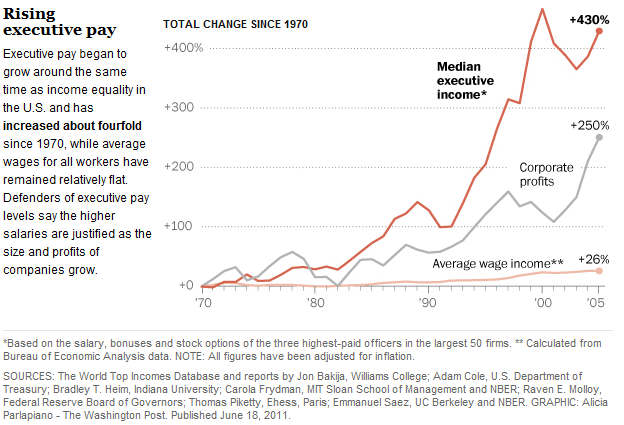 nted on a Washington Post story about increasing inequality between executive pay and the salaries of average Americans. At the time I pointed out that this inequality was apparent in the difference between the CSU Campus Presidents’ pay and faculty salaries.
The recent decision by the Chancellor and the CSU Board of Trustees to approve huge pay increases for the Presidents on the San Diego State and San Luis Obispo campuses elicited nearly unanimous condemnation from faculty, Governor Brown, and members of the California State Assembly. Governor Brown put a fine point on it:
The assumption is that you cannot find a qualified man or woman to lead the university unless paid twice that of the Chief Justice of the United States. I reject this notion.
Researchers for the California Faculty Association have released a graph illustrating the pay of campus presidents and faculty salaries from 1998 through 2011. The gap between the CSU Presidents’ salaries and their faculty salaries looks eerily similar to the Washington Post graphic. Over the last 13 years average presidential salaries have increased from $173,000 to over $300,000, or about 70%. At the same time average faculty salaries have increased just 23%
Predictably, the Chancellor’s tin ear has interpreted complaints about outsized presidential paychecks as an opportunity to advocate further increases in presidential salaries.
This is an especially shocking move given the Chancellor’s offer to faculty over the next three years: ZERO increase during 2011-2012, and pay and benefit CUTS the following two years.
In a recent presentation to a Board of Trustees special committee on presidential compensation the Chancellor argued that, well, the presidents work very hard and so deserve to be paid more. He listed out the many responsibilities of presidents from raising money to emergency preparedness. What he failed to mention is that the presidents have extensive staffs who are responsible for all of those functions.
The extent of the growth in the staff on CSU campuses, and in the CSU system office, is reflected in the obscene growth in the number of administrators in the CSU. As the graph below illustrates, between 1993 and 2010 the ratio of administrators to full time faculty has increased from five administrators for every one faculty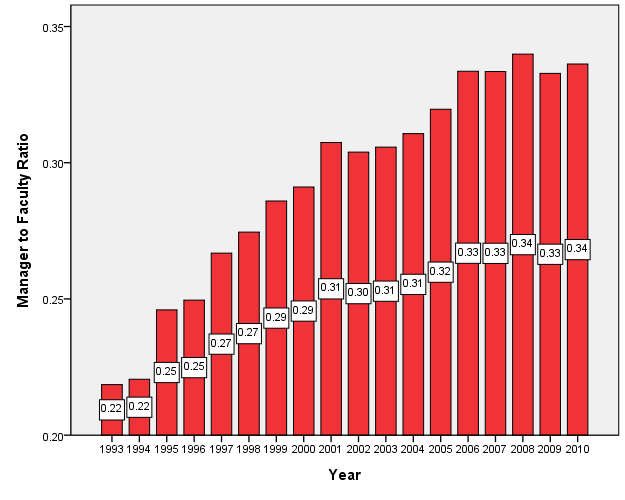 member to about three administrators for every one full time faculty member. It is not as though campus presidents were taking on these tasks all by themselves. If one believed the Chancellor we’d find campus presidents in the lunchroom flipping burgers and in the health center seeing patients.
This trend is consistent with a study by the Goldwater Institute–no denizen of flaming liberals–that blames increasing college costs on “administrative bloat” in American universities.
Unsurprisingly there are several proposed bills rattling around the California Legislature aimed at limiting the pay of CSU executives. In my view none of these bills fully appreciate the issue of executive pay. Salaries should be relative to the value added to the core mission of the university: Education.
I recently argued that presidential salaries should be linked to faculty salaries. Faculty directly service the core mission of the university. In the absence of faculty the university fails to achieve its mission; students are not educated, degrees are not granted, and the preparation of California’s future workforce collapses. If all 23 campus presidents and the Chancellor quit tomorrow the mission of the university would be fulfilled regardless of their absence.
I propose that presidential pay be linked to faculty pay. I am suggesting a very reasonable ratio of three times the average full time faculty salary on the president’s campus. Based on the current figures from CFA this results in an average annual salary of $234,000; a tidy sum, and a $60,000 decrease from the current campus average.
Let’s be honest: CSU presidents make a good living doing socially important work. If they feel that $300,000 a year is unfair, they can move on to a position that pays more. And good riddance. Frankly, I do not want to work with any campus president who’s primary consideration is a paycheck. I want to work for a president who believes that the educational mission of the university is his/her first, second, and third concern.