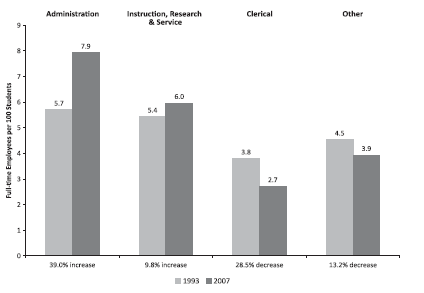
 I stumbled upon an interesting study from the Goldwater Institute a couple of months ago. I referenced in my last post, but I am just getting a chance to blurb it now.
Titled “Administrative Bloat at American Universities: The Real Reason for High Costs in Higher Education” the study puts to rest the idea that increasing college costs are driven by increasing faculty salaries. In fact the study notes that:
The most striking point here is that university spending per student is increasing in real terms, most rapidly in the area of administration. It is not clear why it has cost nearly two-thirds more to administer each student over this 15-year period. We know that universities are hiring many more administrators per student and that they must also be paying those administrators higher salaries and providing them with larger operating budgets. the full study is here
My own calculations based on CFA-provided data suggest that between 1993 and 2007 the ranks of administrators in the CSU grew at a rate similar to the national average.
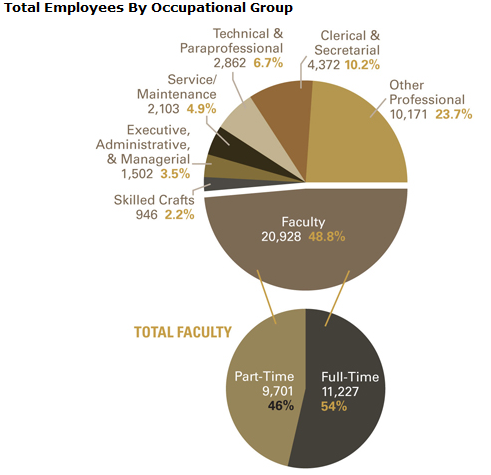 A pie chart from the CSU’s own website illustrates the degree to which classroom-related employment is nearly a minority of the CSU workforce. As the graph illustrates 48% of CSU employees are non-instructional, that is, not faculty. And among faculty only a slight majority are full time, tenure track, permanent faculty. Almost half (46%) of the instructional workforce (teachers) of the CSU is composed of low wage, temporary employees.
It is also worth pointing out that the balance between part-time and full-time faculty has changed considerably since this graph was created. As of 2010 10,893 instructional faculty are part-time lecturers compared to 10,135 full-time faculty (a number that has subsequently declined to 9,971): 48% full time faculty to 52% part-time faculty.
A majority of faculty are now part-time faculty.
Let’s be honest: the growth in the cost of education has less to do with faculty and more to do with administrative bloat in the CSU system, especially the Chancellor’s office. Full-time faculty compose only 25% of the CSU workforce!
The Goldwater Institute report also points out that it is not just the number of administrators has increased, but the expenditures related to administration have increased much faster too:
Inflation-adjusted spending on administration per student increased by 61 percent during the same period, while instructional spending per student rose 39 percent.
This finding is no surprise. As I discussed yesterday, faculty salaries remain flat compared to the salaries of the campus presidents; this is no doubt true of many other CSU management employees.
In my view it is time to start talking about administrative reform in the CSU.