I am not an expert on the presidency; my academic work is focused on the Congress. Whether that makes me an expert on Congress is a matter of heated debate.
Nonetheless, as an academic political scientist I feel I have a license to speak on any political topic, whether I know anything about it or not. And if we learned anything during the Bush years how I feel is way more important that having any actual license to do anything.
It is well accepted in academic circles, and surely in the punditsphere, that the choice of a vice presidential candidate has no influence over the electoral fortunes of the nominee. Few if any voters will cast a vote for Mitt Romney, the argument goes, because he put Paul Ryan (I like to call him mini-Mitt) on the ticket; not enough to make the difference in the outcome of an election anyway.
I have no reason to question this conventional wisdom.
What I wondered this morning (actually last night as I fell asleep) is whether the choice of a Vice Presidential candidate can be conceived of as a leading indicator; that is, the choice predicts the future performance of the candidate.
In the grand tradition of Arthur Laffer–the father of supply-side (i.e., trickle down) economics–I jotted my thoughts on the back of a napkin. Laffer famously pulled off this trick thus dooming the American economy for decades to come. [full disclosure: I used a piece of cardboard that was close enough to me that I did not have to get up to grab a napkin–so the story goes, Laffer really used a napkin. The difference between genius and shit is so thin.]
It seems to me that there are two broad considerations that go into the choice of a vice presidential candidate.
- Is the campaign thinking about the election or about governing after the election?
- Is the campaign looking to preserve its electoral base or expand its electoral coalition?
Enter the napkin, ahem, cardboard.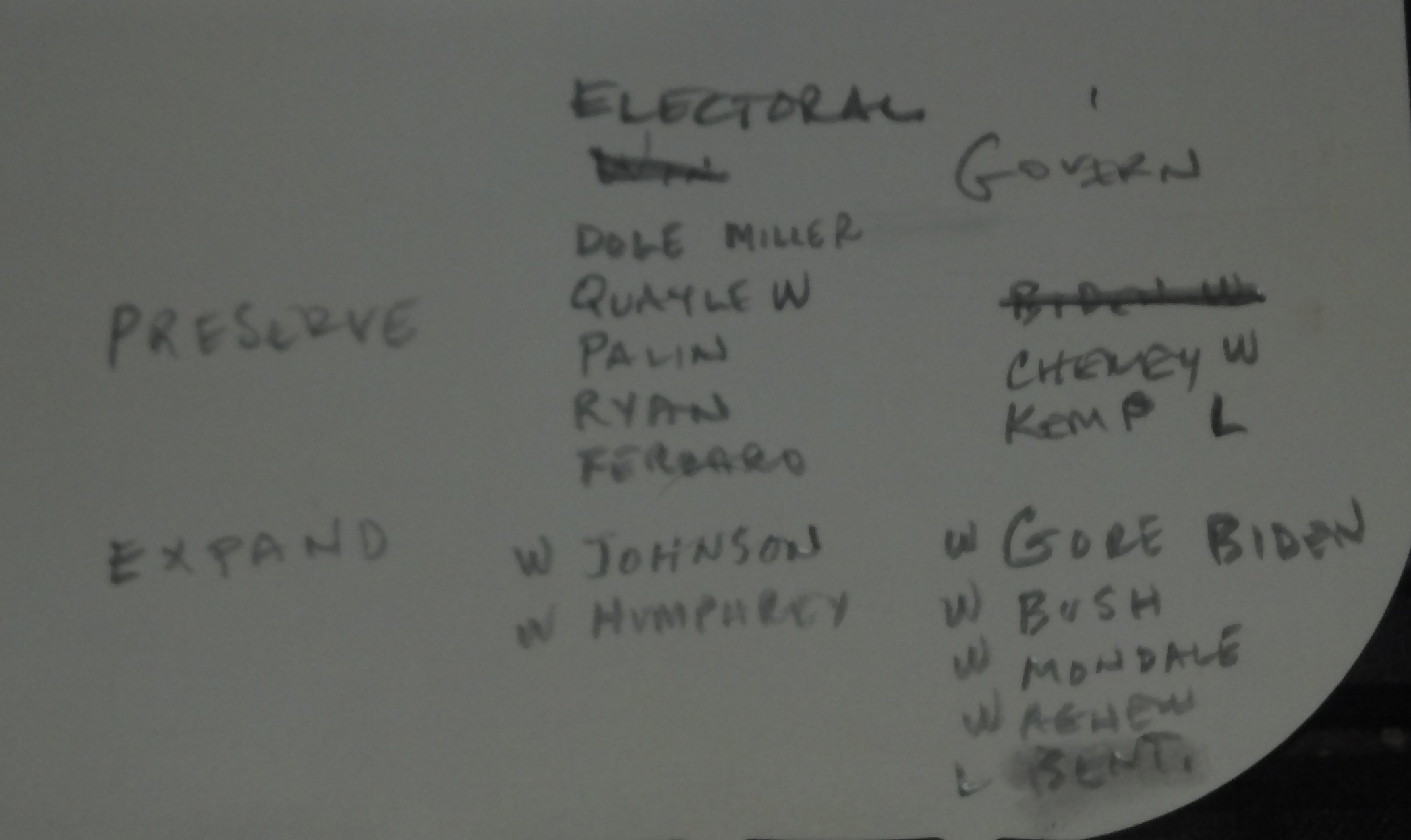
In pure political science tradition I created a two-by-two table reflecting these two considerations. I then classified each of the vice presidential candidates that I could remember since about the 1960s into one of the four resulting cells. The choice of a time range was completely arbitrary. Mostly I just got tired of trying to remember the names of vice presidential candidates [Note: I know I missed a couple; John Edwards and Joe Lieberman being obvious ones.]
My findings suggest that presidential candidates who choose VP nominees with an eye toward governing and simultaneously expanding their electoral coalition tend to win elections. Those candidates who are motivated primarily by electoral concerns to expand their electoral coalitions also do very well.
Thought of another way, VP choices that a mostly driven by the desire to expand the electoral coalition tend to be successful. Those aimed at conserving an existing alignment or electoral base do not do as well.
Capitalizing on the analysis of another more competent political scientist (because I have little interest in actually running the numbers myself) it turns out that “preservationist” nominees are more ideologically extreme than “expandist” nominees (absolute nominate score .425 versus .308–where a score closer to 1.0 is more extreme).
I did the averages that on the backside of the cardboard so it is probably wrong. But it does support the point that “preservationists” tend to be aimed at the base rather than the general electorate, so I will not check my work.
In short: The most important variable is whether the presidential candidate feels electorally vulnerable, thus opting for the base-conserving nominee, or is willing to select a running-mate that hazards to expand his electoral coalition. The former won two of eight elections; the latter won seven of ten elections (including Edwards and Lieberman).
I think this supports the idea that vice presidential choice is a leading indicator; the choice of a vice presidential candidate reflects the feeling inside the campaign (or inside the candidate) about the likelihood of winning in the Fall and predicts success pretty well (though not perfectly…hey this is political science not economics…if we were as terrifically successful as economists like Arthur Laffer…).
I am sure that my political science friends will find much to criticize here. Future research, blah, blah, blah…
Since this is an election year I need to end with a line devoted to what this means for 2102. Well, you notice that the choice of Paul Ryan lands in that upper left-hand cell where things do not turn out well for the presidential candidate.
Now chances are that I am wrong. I usually am (e.g. here and here). I don’t put a high value on prediction anyway; I think prediction is totally overrated. The bad part is that I am not as tragically wrong as Arthur Laffer, and he got an institute named after him!