Ever since I was a child, I tried to be the best…
So what happened?
My family and friends all said I was blessed…
So what happened?–Elder Price, “I Believe,” The Book of Mormon
I did not fully understand Mitt Romney until the musical The Book of Mormon opened in Los Angeles in August. 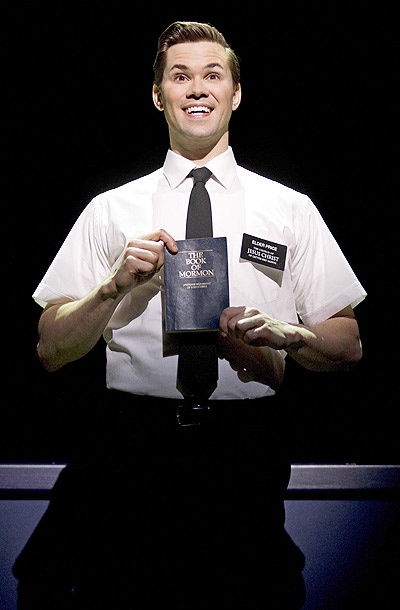
The plot follows two Mormon missionaries who travel to a small village in Africa to win coverts to the faith.
One of the protagonists, Elder Price, fancies himself the golden child of the church. Price has known nothing but success. Clearly, at least to him, he is chosen by god; perfect family, a multitude of friends and admirers, boundless charisma, he is convinced that he is destined to boundless success.
Something incredible…I’ll do something incredible
I want to be the Mormon who changed all of mankind (My best friend…)
It’s something I’ve foreseen: now that I’m nineteen
I’ll do something incredible that blows God’s freaking mind!–Elder Price, “You and Me (But Mostly Me),” The Book of Mormon
Price’s grand plan begins to fall apart quickly. He does not gain the missionary assignment to Europe that he envisions, instead he draws Africa. He is not paired with one of the other handsome and successful missionaries, he is paired with a nerdy, friendless, pathological liar missionary partner who experiences success converting people in the African village. Elder Cunningham uses his skills as a liar to adapt Mormon beliefs to village beliefs and norms that makes him a success. Price’s faith is shaken.
Why? How? Why would god choose anyone other than Price to be successful? He is the chosen one. He is entitled to success. He has done all the right things.
Elder Price distilled everything that I saw in Mitt Romney: A sense of entitlement to success; a sense of entitlement to the presidency; and a palpable condescension toward those who do not deserve success like him.
Mitt Romney’s contempt for those who are not “blessed” (like him and Elder Price) became uncomfortably obvious when leaked video showed Romney complaining about the “47% of Americans” who were “takers.” As first reported in Mother Jones:
…the GOP presidential nominee told attendees of this $50,000-a-plate dinner that 47 percent of Americans—those who back President Obama—are “victims” who are “dependent upon government” and “pay no income tax.” He noted: “My job is not to worry about those people. I’ll never convince them they should take personal responsibility and care for their lives.”
The 47% would never vote for Romney but surely the 53% would; they would reward him with the prize to which he was entitled: the presidency. Romney was so convinced of this that on the day of the election, rather than prepare two speeches for election night (one for victory and one for defeat), he wrote only one speech: A victory speech.
Despite the evidence suggesting that Romney would lose the election (see here and here, for instance), he put his faith in his (now) notoriously wrong internal polls (or a staff unwilling to deliver bad news to their boss), and in a God that would surely deliver votes with his heavenly get-out-the-vote campaign: and he lost.
Did Mitt “man up?” No.
What did Jesus do,
When they sentenced him to die?
Did he try to run away?
Did he just break down and cry?No, Jesus dug down deep,
Knowing what he had to do-
When faced with his own death,
Jesus knew that he had to…Man up.
–Elder Cunningham, “Man Up,” The Book of Mormon
In defeat Romney’s sense of entitlement is even more pronounced.
How could Obama possibly beat God’s chosen candidate? By giving “gifts” to voters; by bribing them; by “corrupting” the electoral process.
According to Romney “What the president’s campaign did was focus on certain members of his base coalition. Give them extraordinary financial gifts from the government, and then work very aggressively to turn them out to vote.” Romney continued:
With regards to the young people…a forgiveness of college loan interest was a big gift. Free contraceptives were very big with young, college-aged women. And then, finally, Obamacare also made a difference for them…anybody now 26 years of age and younger was now going to be part of their parents’ plan, and that was a big gift to young people.
[The Obama healthcare plan’s promise of health care coverage] in perpetuity [was behind the intensity of support for the president.] With regards to African American voters, ‘Obamacare’ was a huge plus — and was highly motivational to African American voters. You can imagine for somebody making $25—, or $30—, or $35,000 a year, being told you’re now going to get free healthcare — particularly if you don’t have it, getting free healthcare worth, what, $10,000 a family, in perpetuity, I mean this is huge. Likewise with Hispanic voters, free healthcare was a big plus. But with regards to Hispanic voters, the amnesty for the children of illegals — the so-called DREAM Act kids — was a huge plus for that voting group…
What the president did was he gave them two things. One, he gave them a big gift on immigration with the DREAM Act amnesty program. Number two, he put in place Obamacare which is basically $10,000 a family. I mean it’s a proven political strategy, which is, give a bunch of money from the government to a group and guess what? They’ll vote for you.
Romney, like Elder Price, believes that he is entitled to fortune, entitled to success, and entitled to position. He believes that others should take individual responsibility, but not him. Like Elder Price, Romney’s quest for success is exclusively about advancing his own greatness.
And there’s no limit to
What we can do
Me and you
But mostly me!–Elder Price, “You and Me (But Mostly Me),” The Book of Mormon